
Square footage tells you how much floor space a room covers. If you know how to calculate square footage, you can order the right amount of flooring, tile, paint, and carpet, compare homes and apartments with confidence, and avoid paying for material you will never use. Most rooms take less than five minutes to measure. You need a tape measure, a pen, and a simple formula. This guide shows you that formula, works through real examples, and covers rooms that are not a plain rectangle, so you can measure any space in your home with confidence.
Quick Overview
- Formula: Length multiplied by width equals area.
- Time: Most rooms take less than 5 minutes to measure.
- L shaped rooms: Split into rectangles, measure each part, add the parts.
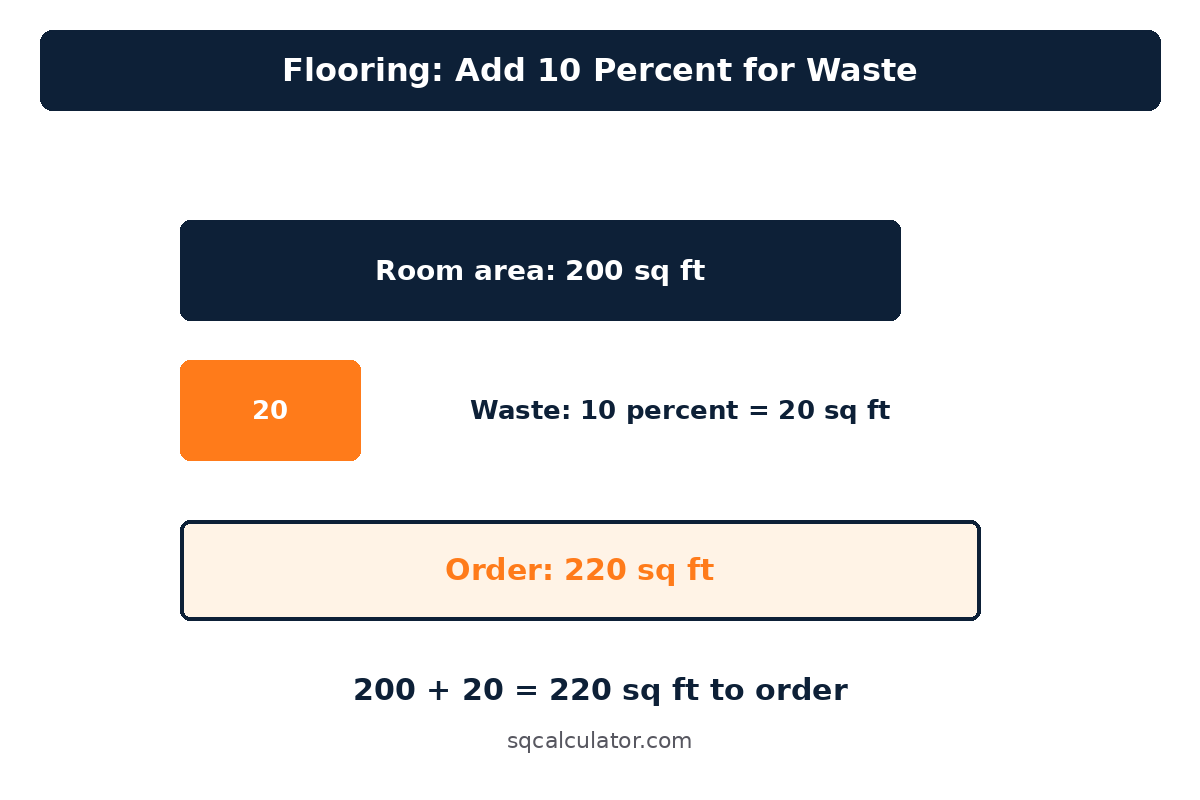
- Flooring: Add 10 percent for waste. A 200 square foot room needs 220 square feet.
- Conversions: 1 square foot equals 0.09290304 square meters.
- Mistake to avoid: Do not mix feet and inches in one multiplication.
What Is Square Footage?
Square footage is the area of a surface, measured in square feet. One square foot is the area of a square that is one foot long and one foot wide. When you see a room listed as 120 square feet, that number describes the floor area inside the room, not the length of one wall. People use square footage every day. Home buyers compare the living area of two homes. Renters check whether a sofa will fit in a living room. Homeowners use it to work out how many boxes of flooring to buy, how many gallons of paint a wall needs, and how much carpet will cover a bedroom floor. Area is always a two dimensional measurement. That is why you multiply two lengths together. Length alone tells you how long a wall is. Width alone tells you how wide a room is. Together, they tell you how much floor you have.
The Basic Square Footage Formula
For a rectangular room, the formula is simple.
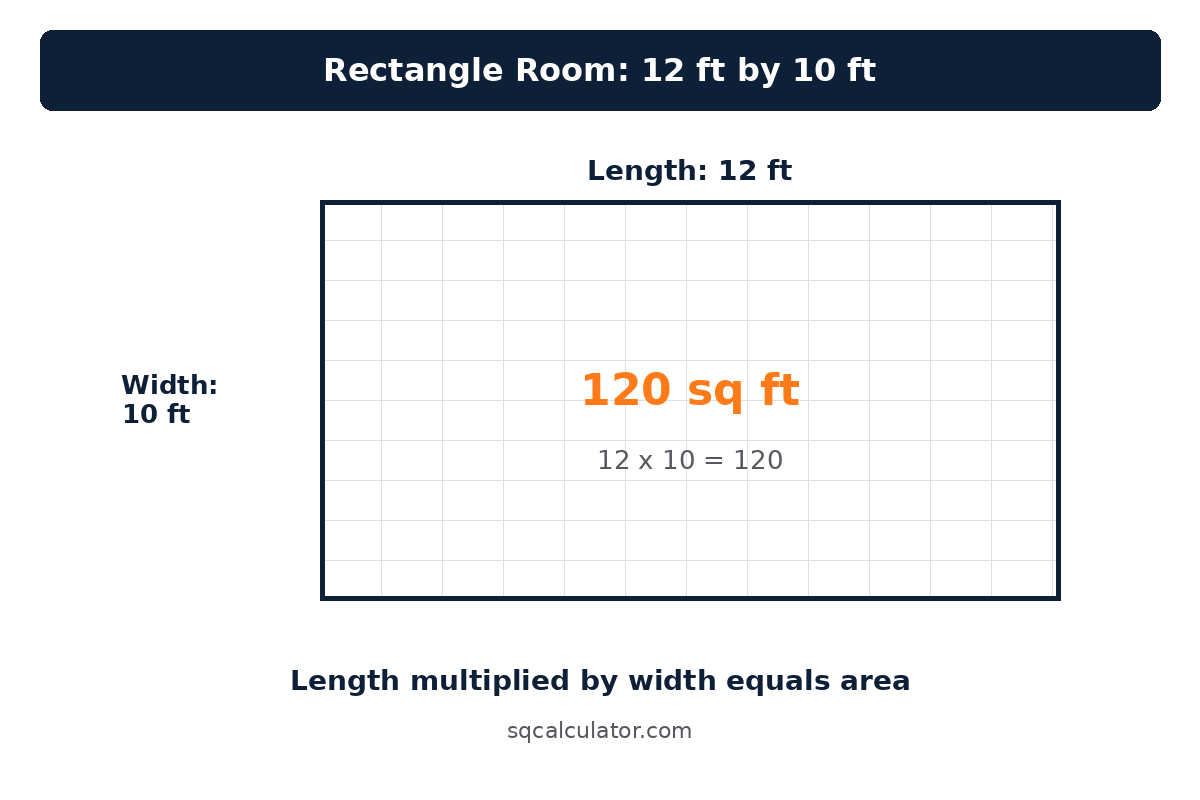
Length multiplied by width equals area.
If a room is 12 feet long and 10 feet wide, multiply 12 by 10. The answer is 120 square feet. Write your measurements in the same unit before you multiply. If one side is in feet and the other side is in inches, convert one of them first. A measurement of 12 feet 6 inches is 12.5 feet. A measurement of 150 inches is also 12.5 feet. Use the same unit on both sides and your answer will be correct.
Common Room Sizes to Check Your Answer
Use this table to sense check your result. If your answer is far from these common sizes, measure again before you order material.
| Room size | Square feet |
|---|---|
| 10 by 10 | 100 |
| 10 by 12 | 120 |
| 12 by 12 | 144 |
| 12 by 15 | 180 |
| 15 by 20 | 300 |
| 20 by 20 | 400 |
| 20 by 25 | 500 |
| 20 by 50 | 1,000 |
A small bedroom is often near 120 square feet. A large living room is often near 300 square feet. A single car garage is often near 240 square feet. These are guides only. Your room is what your tape measure says it is.
How to Measure a Room for Square Footage
Good numbers start with good measuring. Follow these steps in order and you will get a result you can trust.
- Clear the floor along the walls you plan to measure, so the tape can sit flat.
- Measure the length of the room at floor level, from one wall to the opposite wall. Write the number down at once.
- Measure the width in the same way, from one side wall to the other side wall. Write that number down too.
- Measure each wall a second time. If the two readings differ, take the larger reading for material orders, so you do not run short.
- Multiply length by width. The result is the square footage of the room.
- Round up, not down, when you order flooring, tile, or carpet. A little extra covers cuts, waste, and small measuring errors.
A tape measure works well for most rooms. A laser measure is faster for large rooms and long walls, and it helps when furniture is in the way. Measure at floor level, not at ceiling level, because walls can lean slightly and skirting boards can change the reading. Measure in feet and inches, then convert inches to a decimal before you multiply. Six inches is 0.5 feet. Three inches is 0.25 feet. Nine inches is 0.75 feet. This small step prevents the most common error in square footage maths, which is multiplying feet by inches as if they were the same unit.
If you want a fast check of your maths, use the Square Footage Calculator on the homepage. Enter the same length and width, compare the result with your hand calculation, and use the calculator result for your order if the two numbers agree.
How to Calculate Square Footage for Different Room Shapes
Not every room is a rectangle. Use the method below for the shape you have, and add the parts together when a room has more than one shape.
Rectangle and Square Rooms
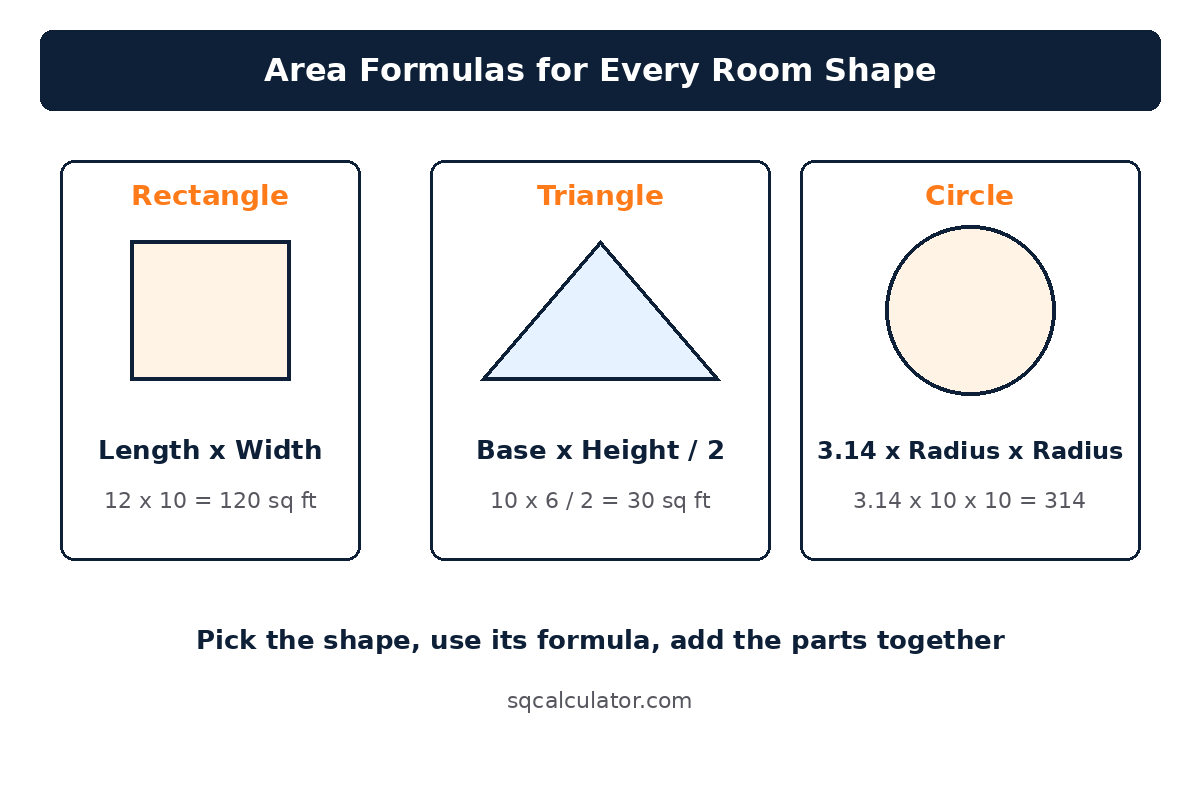
This is the simplest shape. Multiply length by width. A square room of 12 feet by 12 feet is 144 square feet. A rectangular room of 15 feet by 10 feet is 150 square feet. No other step is needed.
L Shaped Rooms
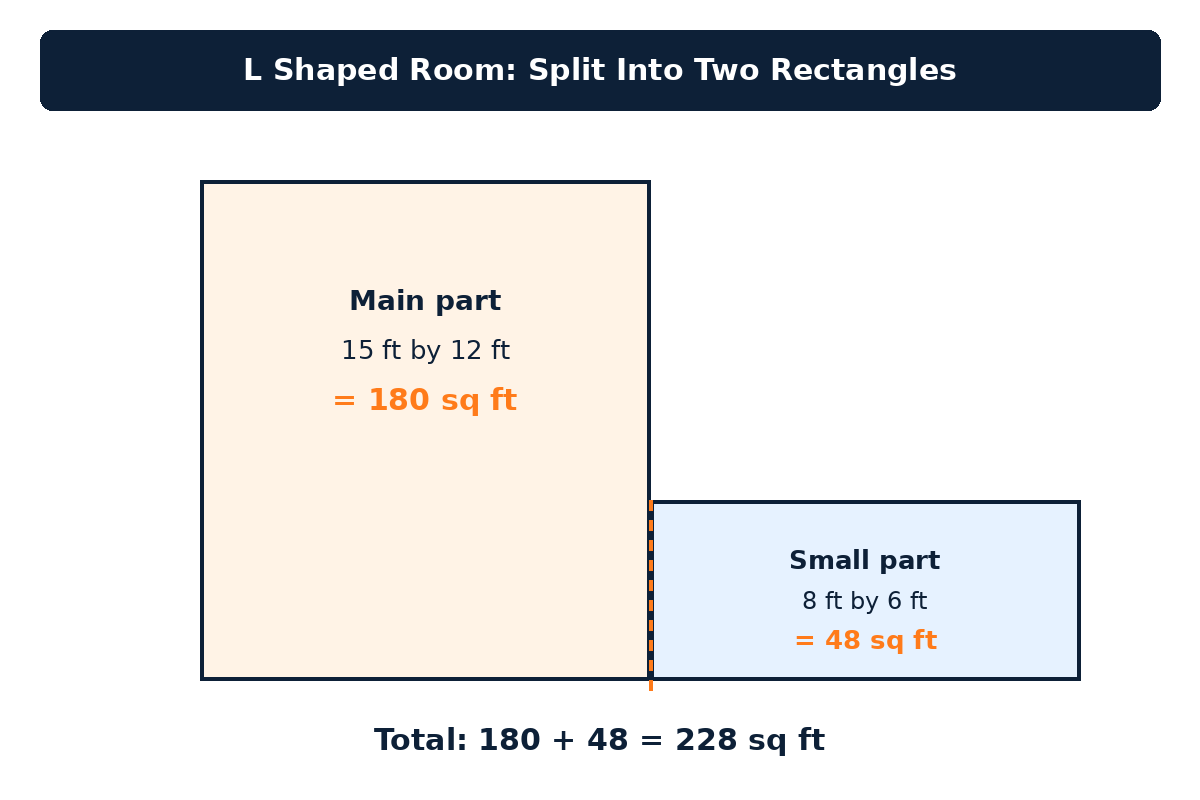
An L shaped room looks hard at first, but it is two rectangles joined together. Split the room into two rectangles along a straight line, measure each rectangle on its own, and add the two areas together. For example, split an L shaped living room into a main rectangle of 15 feet by 12 feet and a smaller rectangle of 8 feet by 6 feet. The main area is 180 square feet. The smaller area is 48 square feet. Add them together and the total is 228 square feet. Draw the split on paper before you measure. Mark each rectangle with a letter, measure each one, and write the area beside it. This keeps the parts separate and stops you counting the same floor twice.
Triangular Rooms
A triangular area uses a different formula. Multiply the base by the height, then divide the answer by two. If a triangular corner is 10 feet across the base and 6 feet from the base to the far point, multiply 10 by 6 to get 60, then divide by two to get 30 square feet. The height is the straight line from the base to the far point, at a right angle to the base, not the length of a sloping side.
Circular Rooms
A circular area uses the radius, which is half the distance across the circle. Multiply 3.14 by the radius multiplied by itself. If a circular room is 20 feet across, the radius is 10 feet. Multiply 3.14 by 10 by 10 and the answer is 314 square feet. If you only need a rough figure for a round rug or a round patio, this formula is accurate enough for an order.
Irregular Rooms and Multiple Areas
For a room with bay windows, alcoves, or an odd corner, split the floor into rectangles, triangles, and circles, work out each part on its own, and add all the parts together. Leave out areas you do not need to cover, such as a built in fireplace base that will stay in place, and add areas you do need to cover, such as a bay window floor that will take the same flooring. Measure each part twice and add the parts in writing, so a single slip does not spoil the total. When the room has many parts, the Square Footage Calculator with multiple areas can keep the running total for you.
How to Calculate Square Footage for Flooring, Tile, Paint and Carpet
Square footage is only the start. Each material needs a little extra, because cuts and waste are part of every real job. For flooring, start with the room area, then add 10 percent for waste. A room of 200 square feet needs about 220 square feet of flooring. If the room is L shaped or has many cuts, add 15 percent instead. Use the flooring calculator to include waste, pack coverage, and material pricing in one result, so your order matches the packs you will actually buy. For tile, the same idea applies, but tile size matters too. Work out the room area, add 10 percent for straight lays and 15 percent for diagonal lays, then check how many tiles fit in one box. Use the tile calculator to work out tile counts and whole box quantities before you order, so you do not end with half a box short. For paint, you need wall area, not floor area. Measure the length of each wall, multiply by the ceiling height, and add the walls together. Subtract the area of doors and windows. Use the wall area calculator for the surface area, then use the paint calculator with your paint coverage and the number of coats you plan to apply. For carpet, measure the room area and add waste for the roll width and the direction of the pile. Carpet is sold in wide rolls, so a room that is wider than one roll will need a join. Use the carpet calculator to include a cutting allowance and to compare area and roll estimates before you buy. Order a little more than the exact area in every case. It is far cheaper to have one spare box than to find the same batch is sold out when you need a few more tiles or boards.
Square Footage Conversions You Will Use Often
Many projects need a second unit. Use these conversions to move between units without error. One square foot equals 0.09290304 square meters. One square foot equals 0.111111 square yards. One square foot equals 144 square inches. One acre equals 43,560 square feet. To convert square feet to square meters, multiply by 0.09290304. A room of 200 square feet is about 18.58 square meters. To convert square meters to square feet, divide by 0.09290304 or multiply by 10.7639. To convert square feet to square yards, divide by 9. A room of 180 square feet is 20 square yards. Use the square feet to square meters converter when you need an exact result for a plan or a listing, and use the square feet to square yards converter when a supplier prices material by the square yard. Remember that area units are squared, so you cannot use a length conversion factor directly. One foot is 0.3048 meters, but one square foot is not 0.3048 square meters. That is the most common conversion error, and it will make your order far too small or far too large.
Common Mistakes to Avoid When You Measure Square Footage
Measure twice and you will avoid most of these errors. The list below covers the mistakes that cause the most wasted material. First, do not mix feet and inches in one multiplication. Convert every measurement to the same unit first. Second, do not measure wall to wall at ceiling height and use it for the floor. Skirting boards, wall lean, and ceiling coving can change the reading. Third, do not count the same area twice in an L shaped room or a room with multiple areas. Draw the split and check that no two parts overlap. Fourth, do not forget doors, windows, and fixed features when you move from floor area to wall area for paint. Subtract them from the wall total. Fifth, do not order the exact area with no waste allowance. Cuts, broken tiles, and pattern matching all use material. Add 10 percent as a starting point and more for complex rooms. Sixth, do not round every measurement before you multiply. Keep decimals in your measurements, multiply first, and round the final result. Rounding early can move the total by several square feet in a large room.
Square Footage Examples You Can Check
Work through these examples and compare your answers with the ones below. Example 1: A bedroom is 12 feet long and 11 feet wide. Multiply 12 by 11 and the answer is 132 square feet. Example 2: A living room is 18 feet long and 14 feet wide. Multiply 18 by 14 and the answer is 252 square feet. Example 3: An L shaped kitchen splits into 14 feet by 10 feet and 6 feet by 6 feet. The first part is 140 square feet. The second part is 36 square feet. Add them together and the total is 176 square feet. Example 4: A circular dining area is 16 feet across. The radius is 8 feet. Multiply 3.14 by 8 by 8 and the answer is about 201 square feet. Example 5: A floor of 250 square feet needs flooring with a 10 percent waste allowance. Ten percent of 250 is 25. Add 25 to 250 and order 275 square feet of flooring. If your answers match these, your method is correct. If one answer differs, check your units first, then check whether you added two parts that overlap.
Frequently Asked Questions
How do I calculate square footage of a room?
Measure the length and the width of the room in feet, then multiply the two numbers together. A room that is 12 feet long and 10 feet wide is 120 square feet. For an L shaped room, split it into rectangles, work out each rectangle, and add the results together.
How do I calculate square footage of a house?
Work out the square footage of each room on its own, then add all the rooms together. Include only the living areas that count for your purpose, such as bedrooms, living rooms, and kitchens, and check local rules for what counts as living area in a home listing or appraisal.
What is the formula for square footage?
For a rectangle, the formula is length multiplied by width. For a triangle, it is base multiplied by height, divided by two. For a circle, it is 3.14 multiplied by the radius multiplied by itself.
How many square feet is a 10 by 10 room?
A 10 by 10 room is 100 square feet. Multiply 10 by 10 and the answer is 100. A 10 by 12 room is 120 square feet, and a 12 by 12 room is 144 square feet.
How do I measure square footage for flooring?
Measure the length and width of the floor, multiply them to get the area, then add 10 percent for waste. A 200 square foot floor needs about 220 square feet of flooring. Use the flooring calculator to include waste and pack coverage before you order.
How do I convert square feet to square meters?
Multiply the square feet by 0.09290304. A room of 200 square feet is about 18.58 square meters. Use the square feet to square meters converter for an exact result.
A Simple Way to Remember It
Square footage is length multiplied by width. Measure carefully, use the same unit on both sides, split odd shapes into simple parts, and add a waste allowance when you order material. Do that, and your numbers will match the floor in front of you. Try your own room now with the Square Footage Calculator on the homepage. Enter your length and width, check the result against your hand calculation, and use it to plan your flooring, tile, paint, or carpet order with confidence.